This statement is made pursuant to the Fighting Against Forced Labour and Child Labour in Supply Chains Act SC 2023. This statement constitutes the slavery and human trafficking statement for Specsavers Canada Inc ("Specsavers") and all its subsidiary companies for its financial year 2025/2026. The board of directors of Specsavers have approved this statement.
Introduction
Specsavers is committed to acting responsibly, trading ethically, and ensuring that the people involved in providing our products are safe. healthy and free from human right abuses.
As part of the Specsavers group of companies. of which Specsavers International Healthcare Limited is the parent company (known as the "Specsavers Group"), Specsavers remains committed to playing its part locally towards preventing and mitigating risks of modern slavery throughout the entire Specsavers business and supply chain.
This Modern Slavery statement outlines the upcoming plans and commitments that Specsavers as a global business has made towards preventing and mitigating risks of modern slavery throughout the business and Specsavers supply chain. Specsavers continues to broaden its understanding of modern slavery risks, strengthen due diligence processes and increase transparency of reporting, whilst also embedding knowledge and understanding of human rights across the Specsavers teams. Specsavers continues to focus and continually advances the business efforts in tackling modern slavery.
Our business and global supply chain
The Specsavers Group includes subsidiaries which are. or support, optical retail outlets, audiology stores and domiciliary partnerships throughout the UK. Republic of Ireland, Northern Europe, Canada, Australia. and New Zealand, as well as Specsavers Group owned manufacturing and distribution sites.
The Specsavers Group has more than 46,000 employees across Guernsey, UK. Republic of Ireland, Netherlands, Denmark, Finland, Sweden, Norway, Hungary. Canada, Australia, New Zealand, Shanghai, and Hong Kong.
The global Specsavers business takes the obligations to combat modern slavery and to trade ethically very seriously, with a dedicated team of experts supporting risk assessment and due diligence activities.
The global supply chain is predominantly managed out of the Specsavers Group's UK and Hong Kong operations on behalf of the entire Specsavers Group (including its Canadian supply chain). Approximately 99% of the Canadian product portfolio is sourced by the global supply chain which therefore requires a global and consistent approach to tackling modern slavery risks and changing demands. A dedicated team of experts (the Regulatory and Compliance teams) supports risk assessment and due diligence activities for supplies to the Specsavers Group.
Our approach
The Specsavers Group is committed to global ethical trading objectives, including ensuring that regular. independent audits of all major suppliers who do not operate in globally recognized regulatory environments are undertaken and monitored.
Wherever possible. the Specsavers Group has, and continues to develop strong, long-term relationships with suppliers so that Specsavers can work in partnership with the suppliers and provide best value eyecare and hearing care to everyone.
Amongst other things, the Specsavers Group's audit program is designed to identify, monitor. and assess that employment is freely chosen. working hours are not excessive, conditions are safe and hygienic, child labour is not used and there are no other occurrences of discriminatory or illegal practices which violate the rights of individuals working within the Specsavers· supply chain.
There is no place for illegal. unethical, or unprofessional conduct within the Specsavers business. We encourage all colleagues to speak up and report if they become aware of any activity that is not consistent with the Specsavers vision and values. and have a whistleblowing policy to protect those who report such activity. Since 2011, the Specsavers Group has reported on activity, business plans and progress relating to reducing modern slavery risk in the Specsavers Annual Review. As part of this reporting and commitment. practices, and procedures to progress and enhance the ethical trading activities, improvement of the transparency of reporting, and training within each region and area of the business continue to be developed.
Identifying and managing risks
Policies and controls
The Regulatory and Compliance teams continue to focus on combatting unethical practices within the global Specsavers business. As some of Specsavers· suppliers are in medium-risk countries, procedures are in place that actively monitor the treatment of employees and adherence to associated regulations within those medium-risk regions.
Contractual protections are put in place to ensure suppliers in high-risk categories are bound by warranties and representations in relation to modern slavery risks within their business. Suppliers are required to adhere to Specsavers' Global Ethical Trading Policy and Specsavers retains the right to independently audit supplier compliance with these principles and requirements.
New suppliers in the product sourcing category are subject to approval processes, including an audit and several compliance checks by the Regulatory and Compliance teams, which the supplier must pass before orders are placed for product. A successful audit result is a prerequisite to the vendor selection process. Functional leaders are supported by the Regulatory and Compliance teams to embed compliance activity into their commercial decisions and supplier performance discussions.
The audits focus on risks associated with modern slavery and human trafficking, including the occurrence of passport retention, illegal documentation, the right to work, illegal deduction of wages, child labour, forced labour, excessive hours of work and illegal subcontracting. Where product suppliers outsource major components to a second-tier supplier, the product supplier is required to share the Specsavers Group policy with the second-tier supplier and monitor their compliance with the terms of the policy.
After an initial audit, new suppliers join the Specsavers Group's monitoring programme and are each audited every two years (as a minimum) by an independent third-party auditor.
Where there is a concern as a result of an audit. the supplier is given a tailored corrective action plan and a timetable within which to take remedial action. If the supplier fails to take the required remedial action, approval of working with this supplier is withheld.
Increasing transparency
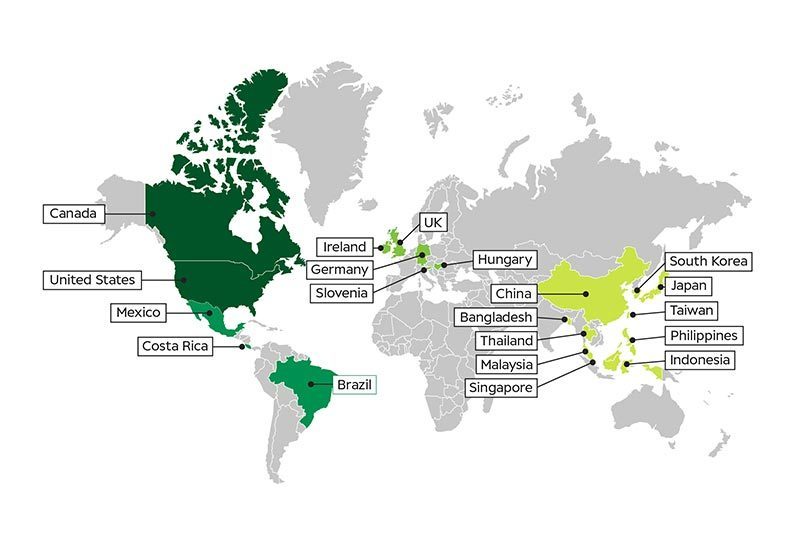
The Specsavers Group is focused on increasing transparency across its supply chain and overall business. The Specsavers Group works with over 70 suppliers and 200 factories in 20 countries and is committed to delivering the highest possible standard of products to every single Specsavers customer. Therefore. understanding where products are sourced and made. and the risks inherent across the supply chain operations. is an essential part of due diligence undertaken.
The product origins for the Specsavers Group are represented on the sourcing map below. Primarily the products come from globally recognized regulatory environments or factories situated in low and medium-risk countries. The activity in the countries which the Specsavers Group source product from is continually monitored to ensure that slavery and human trafficking does not exist within the Specsavers supply chain.
Governance
As part of the Specsavers approach to global supply chain governance. Specsavers Group now has a team dedicated to on boarding our suppliers to the SEDEX platform and monitoring ethics performance In addition to formal audits. key members of the Specsavers Global supply chain team regularly undertake onsite factory visits.
We have formalised our ethics governance process. with issues and non-compliances forming a standing agenda item at quarterly. operating board level meetings Where non-compliances are not able to be resolved by our Regulatory and Compliance teams. our supply chain board are responsible for ensuring that these form part of a discussion with suppliers. Our preference is always to work with suppliers to resolve issues that support them in ensuring that their employees· rights are protected. A key part of our governance process is to ensure that the product directors of our business consider the ethical status of our suppliers and have responsibility for communicating our requirements where issues are identified This process allows us to use commercial leverage if it is required. whilst avoiding a cut and run approach to supplier relationships.
Sustainability: Sourcing Responsibly
Sourcing responsibly is integral to the way we operate. The Specsavers Group works to ensure that the people who make our products have safe and healthy workplaces. where human and civil rights are respected. We also require our suppliers to take the necessary steps to protect the environment.
The Specsavers Group remains committed to our Global Ethical Trading Policy to ensure regular. independent audits of all our major suppliers who do not operate in globally recognized regulatory environments. However. we recognize a need to continuously evolve and enhance how we manage ethical and sustainability risks in our supply chain. As such. the Specsavers Group has commenced issuing its updated Supplier Code of Conduct to all "goods for resale" (GFR) suppliers and its top "goods not for resale" (GNFR). We recognise a need to continuously evolve and enhance how we manage ethical and sustainability risks in our supply chain. As such. we have transitioned our supply base onto the SEDEX platform. giving us increased visibility of ethics within our supply chain.
Alongside this ongoing piece of work. we are developing a comprehensive risk assessment process to allow us to evaluate risks to human rights across our extended value chain. It is expected that the Specsavers Group is able to risk assess our full value chain in the next reporting year.
Our Supplier Code of Conduct lays out our expectations of our suppliers which are aligned with. amongst other topics. The International Labour Organisation's Declaration on Fundamental Principles and Rights to Work. As of August 2024. the Supplier Code of Conduct was issued to and accepted by our top 75 suppliers. representing 65% of our spend on products and services.
Training and awareness raising
Specsavers recognizes the importance of training. raising awareness and embedding knowledge and understanding of human rights. ethical standards and risks across the business. The Specsavers Group has developed training tools for its employees. including whistleblowing training to raise awareness about reporting activity. This year the Specsavers Group have provided extra focus on training Specsavers· core procurement and buying functions through bespoke sessions. Globally. over 27.000 Specsavers colleagues completed our annual modern slavery awareness training. Additionally. the Specsavers Group has prepared and provided guidance materials to stores to support awareness-raising and practical application at a local level. Clear guidelines of how to raise concerns internally and externally were of particular focus within the training. including through Specsavers· third party whistleblowing service who provides the ability to make reports anonymously.
Our progress
Specsavers Group continues to invest in, and develop the Regulatory and Compliance teams to ensure appropriate skills and resources were in place for regulation and compliance relating to forced and child labour.
Specsavers Canada has:
- Identified its local distribution centre in Delta. British Columbia. as the Canadian business that benefits from targeted forced and child labour training and has therefore conducted training sessions on site, discussing the risks of forced and child labour and the importance of adherence with the various Specsavers Group policies and procedures, providing resources and tools future reference
The Specsavers Group has:
- Held a global supplier conference on ethical standards and responsible labour practices, helping to strengthen supplier awareness and understanding of ethical standards and labour practices.
- Delivered global modern slavery training, building awareness and enhancing colleagues ability to recognise and respond to potential modern slavery risks.
- Implemented a revised due diligence process for Buying teams, strengthening controls and reinforcing Specsavers· commitment to protecting workers within its supply chains.
- Increased the number of suppliers connected to SEDEX platform, now covering approximately 70% of goods-for-resale tier 1 suppliers.
- Conducted independent third-party social and environmental audits for 107 supplier sites to enhance protection for workers by identifying and addressing labour and environmental non-compliances more quickly, driving sustained improvements in supplier standards.
Our plans
In 2025/26, the Specsavers Group will remain committed to being ethical and sustainable
across our business and making a positive difference by:
- Ensuring a robust approach to human rights and ethical risks. Working with independent auditors. as well as the introduction of our new systems, enables us to conduct risk assessments and proactively rectify any non-compliance of our policies which are aligned with the Ethical Trade Initiative and the International Labour Organisation;
- Continuing to embed our Supplier Code of Conduct which sets out the behaviours and standards that suppliers must always demonstrate when working with us.
- Ensuring that all of our product suppliers are audited and on boarded onto SEDEX with and Corrective Action Plans in place where required.
- Carrying out risk assessment of our wider value chain to identify further areas of ethics and human rights risk.
- Running communication events with our key suppliers to ensure they understand our expectations regarding the ambitions we have towards our people. communities and planet
- Continuing to educate Specsavers colleagues on the areas of risk within our supply chain and how to identify and manage them.
- Working collaboratively with our suppliers to identify opportunities to share best practice and to drive improvements.
- Identifying areas where we need to engage third party organisations and NGO's to build our knowledge of developing human rights risks.
- Providing clarity within our supplier contracts, not only about how we require them to operate in accordance with internationally- recognised standards. but also the actions that will be taken in the event of non compliance.
- Continuing to evolve and adapt our sustainability related contractual clauses to keep up with changing targets. expectations and regulatory requirements.
- Engaging stakeholders within our value chain to identify areas for improvement
Measuring our progress
The Specsavers Group has committed to adhering to the following key performance indicators to measure the effectiveness of steps taken to tackle modern slavery and human trafficking in the global business:
- All scheduled audits completed with Corrective Action Plans in place and actioned within appropriate timeframes.
- Quarterly board reporting on identified risks of modern slavery and ethical compliance.
In accordance with the requirements of the Act, and in particular section 11 thereof. I attest that I have reviewed the information contained in the report for Specsavers Canada Inc. Based on my knowledge. and having exercised reasonable diligence. I attest that the information in the report is true. accurate and complete in all material respects for the purposes of the Act. for the reporting year listed above. The board of directors of Specsavers Canada Inc. have approved this statement.
Entities owned or controlled by Specsavers Canada Inc. have been consulted in and approved this statement.
Jane Hoban, Managing Director.
As authorized signatory with the authority to bind Specsavers Canda Inc.
Dated: May 25th, 2026